Risk/reward ratio: how to stay profitable while winning only 40%
Risk/reward, break-even win rate and expected value, with a simple 100-trade calculation.
Many new traders only ask "how many trades do I win?". Results actually depend on two things: win rate and risk/reward ratio (R:R). When one is low, the other can still save the account.
What is risk/reward?
The distance from entry to stop is the risk (1R); the distance from entry to target is the reward. With a stop $1,000 away and a target $2,000 away, the ratio is 1:2.
Break-even win rate
Ignoring costs, the win rate needed to break even = 1 / (1 + R):
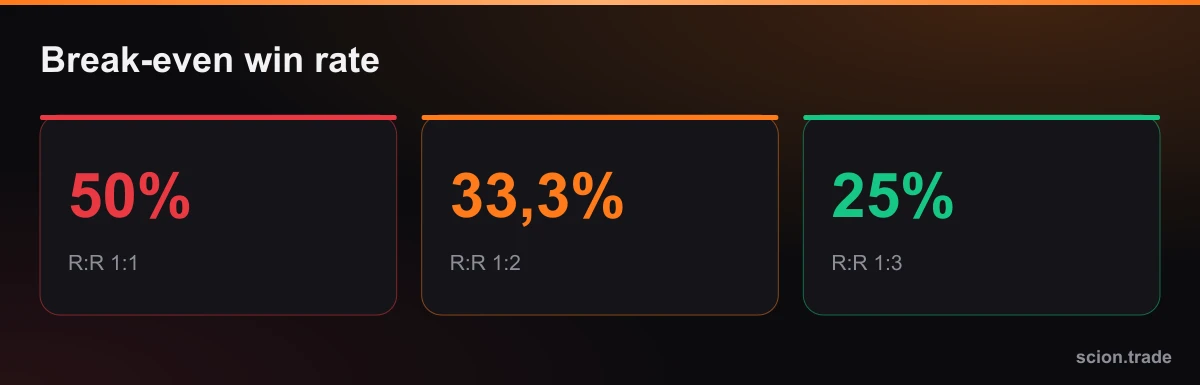
- 1:1 → you need 50%
- 1:2 → 33.3%
- 1:3 → 25%
A 100-trade calculation
Say you win 40% of your trades and risk 1R on each:
- at 1:1: 40 × 1R − 60 × 1R = −20R
- at 1:2: 40 × 2R − 60 × 1R = +20R
- at 1:3: 40 × 3R − 60 × 1R = +60R
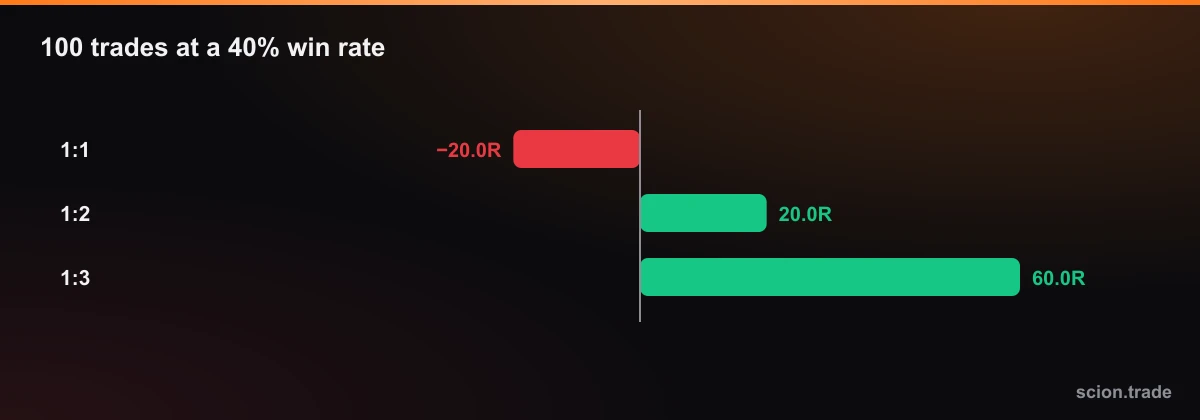
With the same accuracy, only the stop/target structure turns a loss into a profit. If you risk 1% of the account, 1R = 1%, so +20R is roughly +20% (ignoring compounding).
Watch out for
- Targets must be realistic. Writing 1:5 is easy; reaching it is not. Base targets on support/resistance and volatility (ATR).
- Costs shrink R:R. Fees, spread and funding weigh more on small targets.
- Don't move the stop. Moving the stop on a losing trade turns 1R into 2R and breaks the whole system.
Putting it to work
- Before entering, write down entry, stop and target, and compute the ratio.
- If it is below 1:1.5, reconsider the trade.
- Keep risk constant with the position size calculator.
Note: the numbers are a simple example; real results change with costs, slippage and losing streaks.
This material is for educational purposes only and is not investment advice.